Vendor Evaluations
Vendor evaluations turn your purchase history into a scorecard for each supplier — so you buy from the vendors who deliver on quality, time and price, and put the weaker ones on notice. The numbers are built entirely from data you already captured on POs, goods receipts and bills; there is no extra data entry.
Where the scores come from
Everything that happened to PO‑3391 becomes a data point on Gujarat Polychem's card. Each criterion reads a specific field from the documents you posted:
| Criterion | Built from | What PO‑3391 contributed |
|---|---|---|
| Quality | Passed vs. defective quantity from GRN quality checks, plus purchase returns. | 0.5 MT of 29.5 MT HDPE defective → debit note DN‑0574. |
| On‑time delivery | Actual GRN receipt date vs. the PO's expected delivery date. | Expected 18 Jul, received 21 Jul → 3 days late. |
| Fill rate | Quantity received vs. quantity ordered (short‑supply history). | 29.5 MT of 30 MT HDPE received → 0.5 MT short. |
| Price | The vendor's rate vs. your average / best price for the same item. | HDPE at ₹27,600/MT vs. your quarter average ₹27,900. |
Each criterion rolls up into an overall vendor rating for the period you choose.
Gujarat Polychem's scorecard, line by line
Take the four contributions from PO‑3391 and turn them into scores. On a single PO the maths is easy to follow before it blends into the quarter:
| Criterion | Calculation on PO‑3391 | Score |
|---|---|---|
| Quality | Accepted value ₹9,06,400 ÷ received ₹9,20,200 | 98.5% |
| On‑time delivery | Delivered late → the PO counts as a miss (0 of 1 on time) | Late |
| Fill rate | Received value ₹9,20,200 ÷ ordered ₹9,34,000 | 98.5% |
| Price | Rate ₹27,600 vs. your average ₹27,900 → below average is favourable | Good |
:::note Units don't have to match — value does Quality and fill mix a line in MT with a line in kg, so Raya rolls them up by value, not by adding tonnes to kilograms. That's why the 0.5 MT shortfall shows as a 98.5% value fill, not "half a unit short." :::
A default weighting then blends the criteria into one rating. With Quality 40% / On‑time 30% / Fill 20% / Price 10%, a single late‑but‑otherwise‑clean PO pulls the rating down mostly through the on‑time miss — which is the point: late delivery is visible, not buried in an average of tonnes.
How the rating is scaled
Each criterion is normalised to a 0–100 score, then combined by weight into an overall percentage and a star band you can scan at a glance:
| Overall score | Band | Read it as |
|---|---|---|
| 90–100 | ★★★★★ Preferred | Reliable; make it the default vendor. |
| 75–89 | ★★★★ Good | Solid; keep ordering, watch the weak criterion. |
| 60–74 | ★★★ Watch | Mixed record; raise issues before the next PO. |
| Below 60 | ★★ / ★ At risk | Re‑qualify or find an alternative source. |
:::tip Weights are yours to set The 40 / 30 / 20 / 10 split is a sensible default, not a rule. A business that lives or dies on delivery dates can raise On‑time to 50%; a price‑sensitive commodity buyer can lift Price. Adjust the weights in Settings → Purchase & Replenishment so the rating reflects what your procurement actually cares about. :::
Reading the trend
One PO is a data point; a trend is a decision. The card plots each period so you can see direction, not just the latest number — a vendor recovering from a bad quarter is a different conversation from one sliding down three periods in a row:
| Period | Quality | On‑time | Fill | Overall |
|---|---|---|---|---|
| Q4 FY25‑26 | 99% | 92% | 99% | ★★★★★ 94 |
| Q1 FY26‑27 | 98% | 85% | 97% | ★★★★ 88 |
| Q2 FY26‑27 (incl. PO‑3391) | 98% | 74% | 98% | ★★★ 82 |
Here Gujarat Polychem's on‑time slide is the story to act on — the quality and fill stay strong, but late deliveries are dragging the overall band down.
Review a vendor — step by step
- Go to Purchase → Vendor Evaluations.
- Pick a period — month, quarter or year — and, optionally, a category. Choose Q2 FY26‑27 to include PO‑3391.
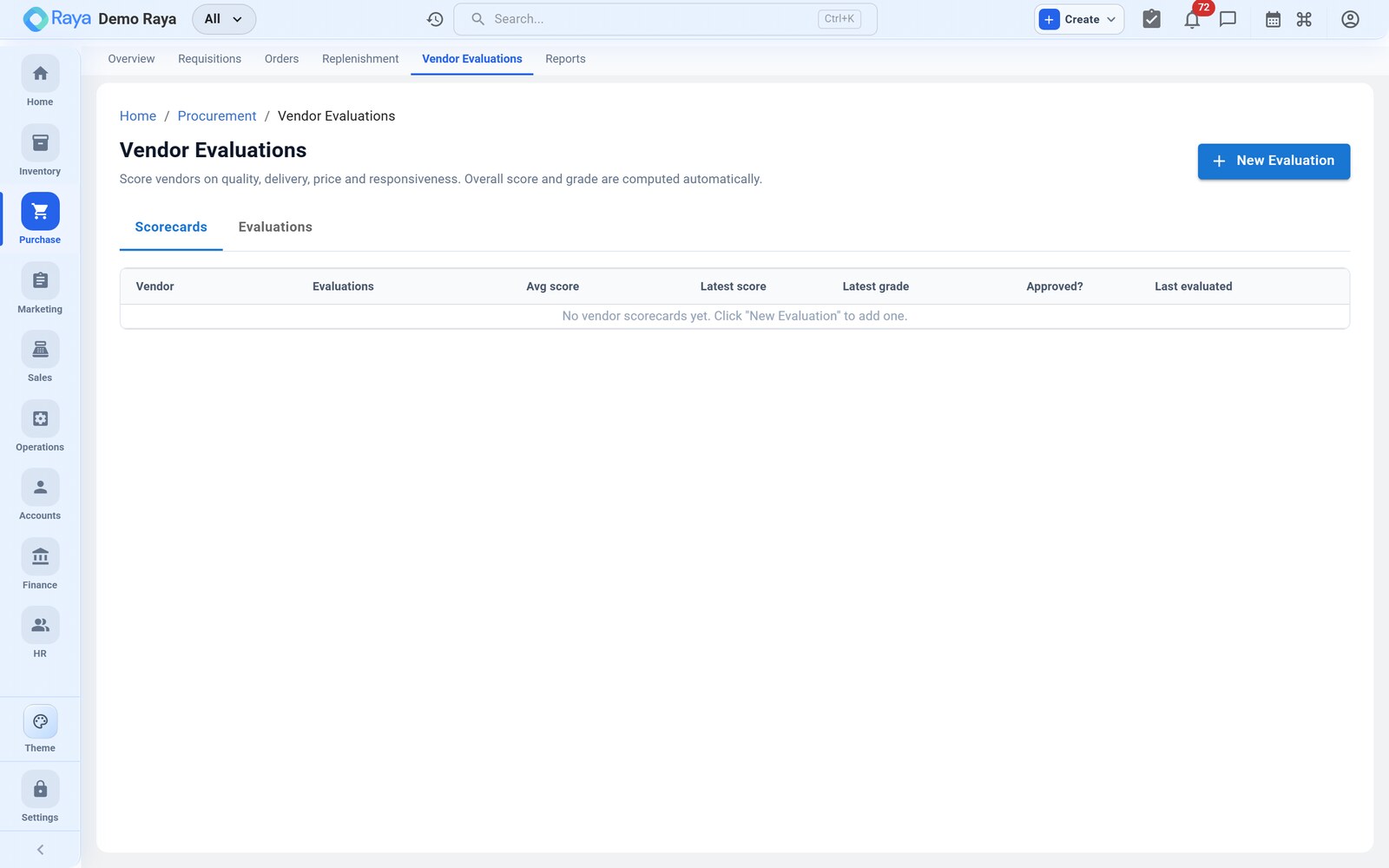
- Open Gujarat Polychem to see the criteria breakdown, the trend over time, and the POs and GRNs behind the numbers — click through to PO‑3391 and GRN‑1187 from the card.
- Add a manual note or adjustment where judgement is needed — for example, if the 3‑day delay was caused by a transporter strike, not the vendor, note it so the on‑time miss is fair.
:::tip Use it while buying When several vendors supply the same item — say two polymer suppliers both quote HDPE — the rating helps you choose. Pair it with the item's purchase history price to balance cost against reliability: the cheapest vendor that keeps missing dates rarely wins once the scorecard is on the table. :::
Acting on the scores
A scorecard is only useful if it changes what you do next:
- Prefer top‑rated vendors as the default supplier for replenishment, so Replenishment suggests your best vendor first.
- Flag underperformers for a conversation before the next order — Gujarat Polychem's short supply and late delivery are worth raising before PO‑3392.
- Tighten terms where quality slips — tighter QC sampling, or hold a bill until the debit note is settled.
- Track improvement by comparing periods side by side; a vendor that fixes its on‑time record should climb the rating next quarter.
:::note Evaluations reflect posted activity only Scores are built from approved POs, completed GRNs, posted bills and posted returns — draft documents don't count. A very new vendor (or one with a single PO like this example) shows limited data until a few transactions build a stable trend, so read one‑PO ratings as indicative, not final. :::
Related
- Goods Receipt (GRN) — the quality and delivery data that feeds scores.
- Purchase Returns — returns that pull the quality score down.
- Replenishment — buy more from your best‑rated vendors.
- Purchase Orders — price, dates and terms the scorecard reads.
- Procure‑to‑Pay workflow — the full cycle, end to end.
- Finance — vendor ledgers and spend.