Goods Receipt (GRN) & Quality Check
A Goods Receipt Note (GRN) records what actually arrived against a purchase order and lets you inspect it line by line. One click brings stock, batches, putaway and the vendor ledger up to date — and posts the first accounting voucher of the purchase.
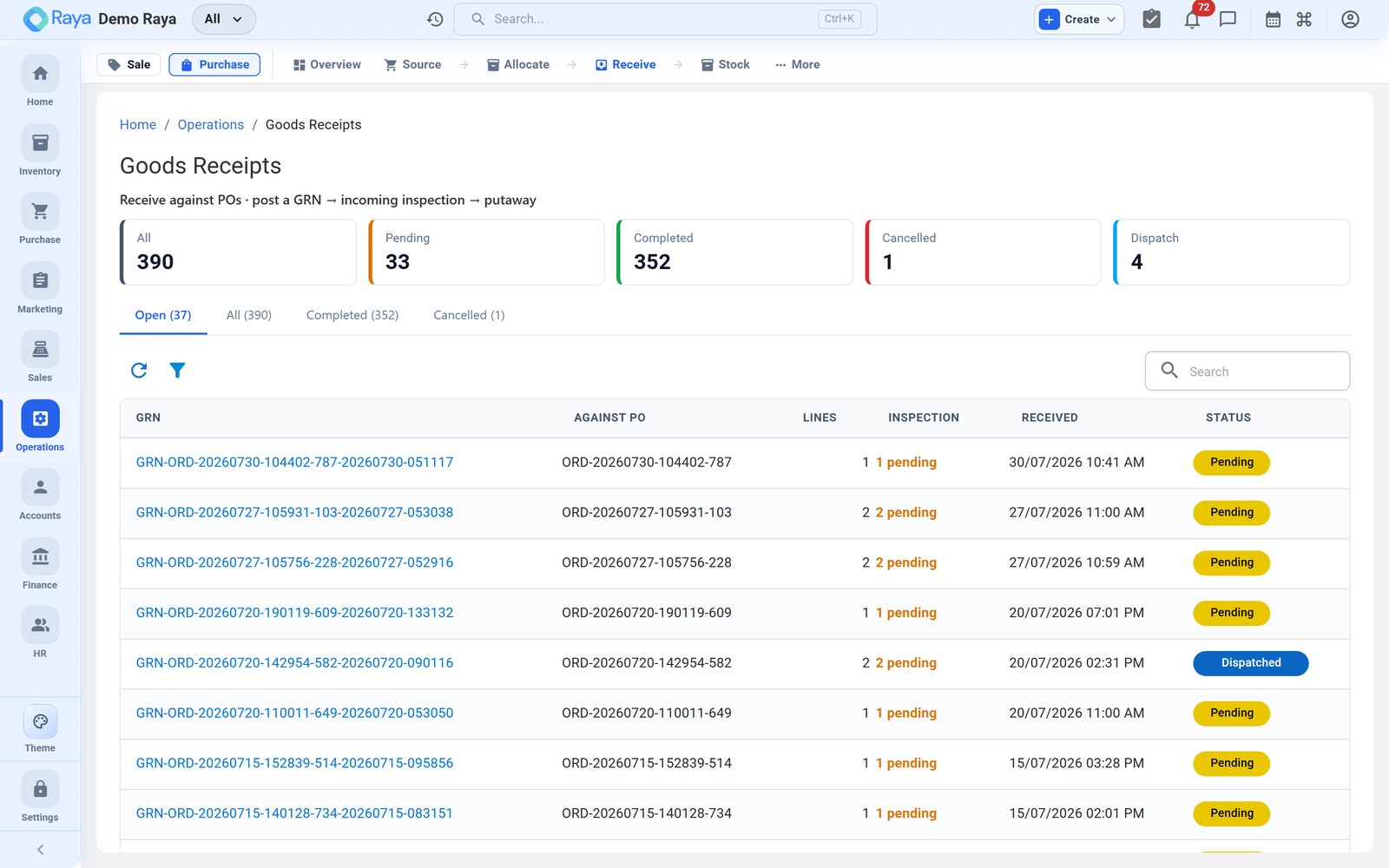
What arrives against PO‑3391
Gujarat Polychem delivers on 21 Jul 2026 (three days after the expected 18 Jul). The truck carries less than the full order, and one part of it fails inspection — exactly the real‑world case a GRN is built for:
| Line | Ordered | Received | QC accepted | QC defective |
|---|---|---|---|---|
| HDPE Granules | 30 MT | 29.5 MT (0.5 short) | 29.0 MT | 0.5 MT (wet / contaminated bags) |
| Masterbatch (white) | 400 kg | 400 kg | 400 kg | – |
We'll record this as GRN‑1187.
1. Record the receipt
- Open PO‑3391 and go to Receive → + New Receipt (or Purchase → Goods Receipts → + New).
- Tick the lines that arrived this time — partial receipts are fine. Both lines arrived here, so tick both.
- Enter the received quantity per line: 29.5 MT for HDPE, 400 kg for masterbatch.
- Capture shipment details if the vendor sent them — carrier, vehicle number, LR (lorry receipt) number, e‑Way Bill number and dispatch date. These show on the inbound‑tracking dashboard.
- Move to the per‑line quality check below before you click Receive.
2. Per‑line quality check — accepted vs defective
For each received line, split the quantity by inspection result. On the HDPE line, 0.5 MT of bags came in wet, so split 29.0 accepted / 0.5 defective:
| Field | Enter | Where it goes |
|---|---|---|
| Passed quantity | 29.0 MT (HDPE) · 400 kg (MB) | Into available stock at the Bhiwandi Warehouse. |
| Defective quantity | 0.5 MT (HDPE) | Held in a Quarantine sub‑location, out of available stock. |
The masterbatch passes in full, so its whole 400 kg is accepted.
3. Capture the batch / lot
Both items are batch‑tracked, so as you receive, enter the batch details Raya uses for FIFO costing and expiry control:
| Field | HDPE line | Masterbatch line |
|---|---|---|
| Batch / lot number | B‑HDPE‑2607 | B‑MB‑2609 |
| Manufacture date | 25 Jun 2026 | 28 Jun 2026 |
| Expiry date | (as printed) | (as printed) |
Raya creates each batch at its landed cost and allocates it FIFO for future issues. Click Receive to post GRN‑1187.
:::caution Short supply — 0.5 MT Received quantity (29.5 MT) is less than ordered (30 MT). Raya flags the 0.5 MT shortfall so it surfaces in the three‑way match and keeps PO‑3391 at Partially Received on the "awaiting receipt" list. Either chase the balance shipment or close the PO line if the vendor won't supply it. :::
4. The Inventory Receipt voucher (Dr/Cr)
Posting the GRN books the goods before the bill arrives, so stock is never on the shelf but off the ledger. Raya values the receipt at received quantity × PO rate — both accepted and quarantined stock, because quarantine is still your inventory:
HDPE ...... 29.5 MT × 27,600 = 8,14,200
Masterbatch  400 kg × 265    = 1,06,000
                              ----------
Received value ............... 9,20,200
Dr  Inventory (Raw Materials) ........... 9,20,200
    Cr  GRNI — Goods Received Not Invoiced ... 9,20,200
GRNI is a clearing (GR/IR) account: the GRN credits it now, and the vendor's bill will debit it, netting it to zero once invoice and goods have met.
What updates automatically
Recording the GRN does the downstream work for you — no re‑keying:
- Stock — the 29.0 MT + 400 kg passed quantities are added to on‑hand at the Bhiwandi Warehouse; the 0.5 MT sits in Quarantine.
- FIFO batch — batches B‑HDPE‑2607 and B‑MB‑2609 are created with their cost, manufacture and expiry dates, ready for FIFO issue.
- Putaway — a task is generated to move the accepted stock from the dock to its storage rack.
- Vendor ledger — the receipt is recorded against Gujarat Polychem, ready for billing.
- Inventory Receipt voucher — posted (the entry above) so the goods are on the books.
- Defect return — the 0.5 MT defective auto‑drafts a purchase return for review (see Purchase Returns).
- GRN PDF — generated for the vendor and your records.
5. Three‑way match: PO ↔ GRN ↔ Bill
The GRN is the middle link. When Finance enters the vendor's bill VB‑2094 (dated 22 Jul, due 05 Sep on Net 45), Raya reconciles three documents before any money moves:
| Check | PO‑3391 | GRN‑1187 | Bill VB‑2094 | Result |
|---|---|---|---|---|
| Price | ₹27,600 / MT | – | ₹27,600 / MT | ✓ matches |
| Quantity | 30 MT ordered | 29.5 MT received | 29.5 MT billed | ✓ bill = GRN |
| Open balance | 0.5 MT un‑received | – | not billed | ⚠ short‑supply flag |
The vendor bills only what they shipped (29.5 MT + 400 kg), so the bill agrees with the GRN. The purchase voucher posts with Input IGST (ITC) and §194Q TDS withheld (assume purchases from this vendor already crossed ₹50 lakh this year, so 0.1% bites the whole taxable value):
TDS §194Q = 0.1% × 9,20,200 = 920
Dr  GRNI — Goods Received Not Invoiced ... 9,20,200
Dr  Input IGST (ITC) .................... 1,65,636
    Cr  Accounts Payable (Gujarat Polychem) . 10,84,916
    Cr  TDS Payable (§194Q) ...................... 920
Debits (₹10,85,836) equal credits (₹10,85,836). The GRNI account nets to zero (₹9,20,200 credited by the GRN, debited by the bill), leaving Inventory on one side and A/P on the other. The Input IGST ₹1,65,636 is now your claimable ITC.
:::note §194Q, not §206C(1H) When you deduct §194Q on a goods purchase, the seller must not also collect TCS under §206C(1H) on the same transaction — the buyer's TDS takes precedence. Raya stamps the section so it flows to your Form 26Q. See TDS for thresholds and challans. :::
:::tip Release payment after the match Once the three‑way match is clean, Finance releases payment against the bill. Because the 0.5 MT defective goes back on a debit note first, the amount actually paid is the net of the bill and the debit note — walked through under Purchase Returns → Settling the debit note. :::
Related
- Purchase Returns & Debit Notes — send the 0.5 MT defective back.
- Purchase Orders — the PO this receives against.
- Procure‑to‑Pay workflow — the full cycle, end to end.
- Vouchers — the Inventory Receipt and Purchase entries.
- Inventory — batches, putaway and stock valuation.