Purchase
Purchase is where you buy — turning a need into a purchase order, receiving and inspecting the goods, and matching everything three ways before Finance pays the vendor. It is the mirror of Sales, built for Indian GST, three‑way match and TDS.
One worked example, followed to the end
Every page in this module follows the same order so you can watch a purchase move from a need on the shop floor all the way to a cleared payment. Meet PO‑3391, placed on your Bhiwandi Warehouse (Maharashtra) with the vendor Gujarat Polychem (Vapi, Gujarat):
| Line | Item | HSN | Qty | Rate | Amount |
|---|---|---|---|---|---|
| 1 | HDPE Granules | 3901 | 30 MT | ₹27,600 / MT | ₹8,28,000 |
| 2 | Masterbatch (white) | 3206 | 400 kg | ₹265 / kg | ₹1,06,000 |
| Taxable value | ₹9,34,000 | ||||
| IGST @ 18% (inter‑state) | ₹1,68,120 | ||||
| PO value | ₹11,02,120 |
Terms are Net 45 days. Because the vendor's GSTIN starts 24 (Gujarat) and the delivery state is 27 (Maharashtra), the supply is inter‑state, so Raya applies IGST 18% rather than CGST + SGST. Follow this order through each page:
- Someone raises a requisition for the granules → Requisitions.
- It becomes PO‑3391, approved and emailed to the vendor → Purchase Orders.
- GRN‑1187 receives 29.5 MT (0.5 MT short) with a per‑line QC → Goods Receipt.
- Bill VB‑2094 is three‑way matched with §194Q TDS, then paid → below and in Finance.
- The 0.5 MT defective HDPE goes back on a debit note → Purchase Returns.
- The vendor's quality, delivery and price roll into a scorecard → Vendor Evaluations.
The procure‑to‑pay story
A typical purchase runs end to end without re‑keying:
- A need arises — someone raises a requisition, a replenishment suggestion fires when stock hits its reorder point, or a sales order asks you to procure the shortfall.
- You issue a PO — pick the vendor, confirm rates and terms, and approve it. GST splits automatically into CGST/SGST or IGST from the place of supply.
- Goods arrive — you record a Goods Receipt (GRN) and run a per‑line quality check. Stock, batches, putaway and the vendor ledger update on their own.
- Finance pays — the vendor's bill is matched PO ↔ GRN ↔ Bill, Input GST (ITC) is captured, TDS §194Q is applied where it's due, and payment is allocated bill‑wise.
Anything defective can be sent back with a purchase return / debit note, which reverses both the stock and the ITC.
Purchase order lifecycle
A PO moves through clear states so everyone knows what's outstanding:
   Draft  →  Approved / Sent  →  Partially Received  →  Received (Completed)
                                                              │
                                                              └──→  Billed  →  Paid
   (Cancellable at any point before it is fully received)
| State | Meaning | Where PO‑3391 is |
|---|---|---|
| Draft | Being prepared; not yet committed. Fully editable and cancellable. | Where it starts |
| Approved / Sent | Signed off and emailed to the vendor; the receipt is now seeded. | After the buyer approves |
| Partially Received | Some lines or quantities have arrived via a GRN. | After GRN‑1187 (0.5 MT still due) |
| Received (Completed) | Everything ordered has been received (or the balance closed). | After the short 0.5 MT is closed |
Alongside the state, a PO carries a separate payment status — Unpaid → Partial → Paid — that Finance drives once billing starts.
A PO can be cancelled at any point before it is fully received. Once billing starts, the bill and payment status are tracked separately in Finance so an unpaid, fully‑received PO is never mistaken for an open order.
Where each step posts to Finance
Three documents in the cycle post accounting vouchers. Keeping them straight is the key to a clean vendor ledger:
| Document | Voucher posted | The one‑line effect |
|---|---|---|
| GRN‑1187 | Inventory Receipt | Dr Inventory / Cr GRNI — stock on the books before the bill |
| Bill VB‑2094 | Purchase (+ ITC, − TDS) | Dr GRNI + Dr Input IGST / Cr A/P + Cr TDS Payable |
| Debit note (return) | Debit Note | Dr A/P / Cr Purchase Returns + Cr Input IGST (ITC reversed) |
| Payment | Payment | Dr A/P / Cr Bank |
Full Dr/Cr walk‑throughs live on each page. The GRNI (Goods Received Not Invoiced) clearing account is credited by the GRN and debited by the bill, so it nets to zero once both are posted — the classic proof that goods and invoice have met.
Sub‑pages
| Sub‑tab | What it's for |
|---|---|
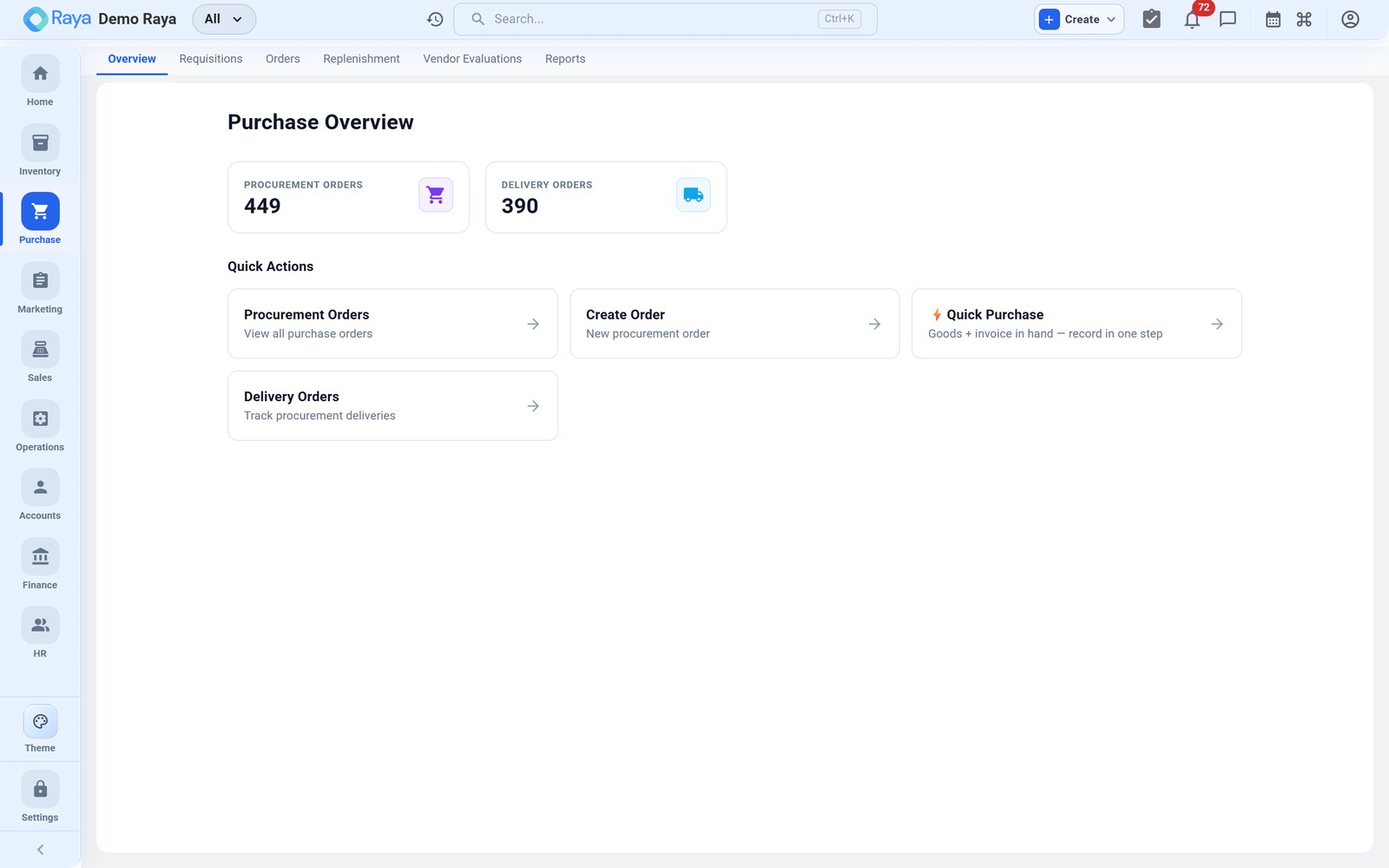
| Overview | Procurement KPIs and quick links |
| Requisitions | Internal requests to buy, routed for approval |
| Purchase Orders | Create, approve and send POs to vendors |
| Goods Receipt (GRN) | Receive and quality‑check incoming stock |
| Purchase Returns | Send goods back and raise debit notes |
| Replenishment | Reorder‑point suggestions for what to buy next |
| Import Purchase | Foreign vendors — customs IGST, RCM and FX |
| Vendor Evaluations | Score vendors on quality, delivery and price |
Procurement KPIs
The overview surfaces what the buying team watches daily:
- Open POs — count and value still to be received.
- Awaiting receipt — POs past their expected delivery date (PO‑3391 sits here from its expected 18 Jul until GRN‑1187 posts on 21 Jul).
- Outstanding payables — aged 0–30, 31–60, 61–90 and 90+ days.
- Top vendors and spend by category for the current period.
Related
- Procure‑to‑Pay workflow — the full cycle, step by step.
- Finance — vendor bills, TDS, payments and ledgers.
- Vouchers — the Dr/Cr entries every step posts.
- Inventory — where received stock lands and is valued.